

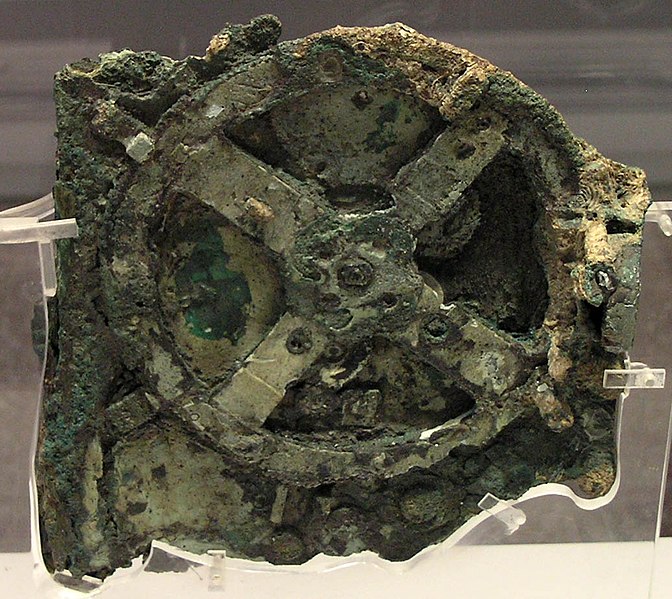
I just learned about this thing today in my Astronomy Before the Telescope class. It's a one-of-a-kind tool used by Ancient Greeks to predict eclipses, phases of the moon, positions of the sun and the moon in the sky, and to calculate how many months would be in each year (most had 12, some had 13 to make up for the fact that lunar months are shorter than solar months), combining technology and astronomical theory from both Greece and Babylon. What's left of this artifact is the image on the bottom. The top and middle are recreations of what the mechanism might have looked like (they're the front and back, respectively). It's fantastically complex, featuring gear work that keeps all that information tabulated with the turn of just one crank. It seems the kind of fascinating thing that's ripe for conspiracy theories. I almost expect Dan Brown to write some kind of novel about the thing.
5-Brice Peterson: The Antikythera Mechanism
Thursday, February 26, 2009 | |
Just a reminder to everyone
| |
If you're interested in getting involved in the BRYTE installation (building a large installation piece from the stories of refugee children) send an email to Sarah Abarbanel at sfabarbanel@gmail.com.
DO IT! (YOU WON'T DO IT)
3 - Jiwon Kim: hybrid art
Wednesday, February 25, 2009 | |
Fashion and Music
at NY Fashion Week
Fall 2009
Carlos Miele
Zac Posen
2 - Jiwon Kim - Creative Process
| |
Before the discussion today in class, I was actually going to write about creative processes that occur in dreams. I actually have had a couple of really vivid dreams that I wake up from and quickly sketch out what I saw because I don’t want to forget all the colors and the creative concepts. Sometimes the dreams are of a very fantasy-like abstract kind of world, sometimes they just very straightforwardly give me an idea for a project (I am working on the project in the dream). These dreams actually became inspirations for some of my artwork. I was actually going to find the original sketch I did about a dream, scan it and upload it, but I’m having trouble finding the page…
But since we already discussed dreams in class today, … I’m gonna say.. my creative process sometimes comes from illusory perceptions. For example, once, I happened to glance over at the back cover of a magazine lying on the floor(it was an advertisement with two girls in the background, and an enlarged bag in the front), and I thought saw an outfit—a denim corset with gold military style buttons down the middle and a Bohemian frill skirt matched with it. But taking a second look, that wasn’t at all what the picture was of. I just saw the advertisement of the Gucci bag, and mistakenly saw an outfit. This may have just happened because of my nearly blind eyesight, but still it was an accident that lead to a creative process?
Creative Process
| |
This question is a little difficult for me because i am new to the creative process, or rather to the expression of my creative process game. But for blog-sake, this is how i think i would like to describe how my mind works:
Usually, i have a concept in my head that i am struggling with; i concentrate on the subject or problem for a full five minutes... thinking about it or, more likely, how to solve it or express it, then i forget about it completely. I try to continue about my regular business as if i had not been thinking of anything at all. After maybe a few hours or a few days i'll just happen to see something that somehow, subconsciously, relates. this moment of recognition suddenly gives me a new hand hold to work with. This process doesn't seem to stop, but rather continues even after i thought i was finished.
When first trying to design objects, chairs, tables, or anything, i would start with an end goal. with this method i came up with Ikea-replicables. Now, i tried to begin with a concept or an aesthetic--by the way, i still have not found a suitable definition for this word--and work from there... hence the process described above.
p.s if anybody has any non-dictionary definitions or translations of "aesthetic" please let me know.
2- Audrey: creative process
| |
My creative process stems from a difficulty merging the conceptual and subconscious sides of my brain. Art for me has mostly emerged from my subconscious yet this can be dangerous when I need to put a title or description on a work. Similarly, other forms of art like video, music, and writing have all been inspired by too many emotions at one time (to the point where I am unsure what any of them are) and simply letting myself go. While I enjoy these creative sessions of emotions and ideas, I would like to maintain some order and organization. When I become too caught up with my subconscious, I am either horrified or elated by the end result. I would much rather utilize my conceptual side along with aspects of my subconscious side to stabilize my creative process.
6-Steve Larrick: The Creative Process
| |
I do not passively wait for inspiration to strike me, but instead actively seek it out. I carry a notebook in my back pocket at all times in order to capture any ideas or idle thoughts, which may eventually develop into something more.
My creative process (with respect to art) can be either aesthetically driven or conceptually driven. In each case, inspiration from outside of myself is required.
Much of my inspiration comes from humor. Humor for the most part comes from people, rather than nature, so it is people I watch when seeking humor. If ever I take part in, or observe a conversation that makes me laugh, I record the funny in my notebook. If ever I notice people acting in a way that makes me laugh or act in such a way myself, I record the funny in my notebook. I write it down when I see a hipster in Nice Slice sprinkling parmigiana cheese on the vegan slice of pizza he just ordered. I quote myself when in conversation I utter, "The thing about slippery slope arguments is that, if people start using them, what kind of even worse arguments are they gonna come up with next?". This recorded humor often develops into a concept, funny or not, which I then incorporate into my art.
I also record interesting ideas which are not particularly humorous. These too are jotted down in my notebook and come from my daily observations. They are often emotive in nature. A few found examples include the moral dilemma of whether or not to kill a mosquito, or the depressing imagery of timed sprinklers going off in the rain.
Whether a concept inspired by humor or another emotion, transforming that concept into art always involves a cohesive embodiment of that concept. The medium, subject matter depicted, and style with which I depict a subject matter must all fit with the concept exactly to my liking.
In addition to conceptually driven art, I also partake in a creative process primarily driven by aesthetics. When this is the case, the inspiration often comes from something I see myself that strikes me as something others should also see, such as the way sunlight strikes the texture of tree bark at a particular time of day.
lot's to discuss- RICHARD
| |
First of all I can't wait to tell you all about my newly envisioned sculpture inspired by Jenna's reference to the Aeolan Harp -
6- Jenna Kaye-Kauderer: Creative Process
| |
I used to be a huge procrastinator. I would save everything for the last minute: projects, papers, problem sets, you name it. On the positive side, this forced me to be efficient and focused when I finally did begin my work. However, in the past two years I have realized two really important things about myself. The first is that the reason I would procrastinate was because I was afraid. I felt an intense pressure to precisely finish everything I started. I put too much importance on perfecting every detail, afraid to allow myself to make mistakes, to go back and revise, edit and start over. The second thing I realized is that I do my best work when I don't feel this pressure, when I begin things early, when I leave myself room to come up with many ideas, to try them out before I commit to them. I love to have time to think. In fact, I believe I come up with my most creative ideas when there is no pressure to come up with them at all. I am a huge fan of taking long, aimless walks during which I can let my mind wander. I also love brainstorming ideas right before I fall asleep, a time when I have nothing else to do but lie in bed and think. I have also found, related to our train discussion in class, that I think well on long car rides, when I can just stare out the window, listen to music and think, with no pressure, or deadline or immediate goal. Other places I think most creatively: when I am skiing, swimming (doing laps or floating in the ocean) and taking baths.
creative process - andrew
| |
going off a lot of the things that have already been said (which may reveal something about my creative process in itself), i feel like i become inspired by certain stimuli, whether they be the introduction of an art assignment or a photograph or someone else's music or drawing or an idea of any kind... it will kind of get me thinking about what this thing means to me. how can i make it my own? how can i take what is there and change it in an interesting way? i think that perhaps this notion is maybe not the best way to go about being creative, since i might not always have a stimulus, or enough of a stimulus to act upon it in a creative way. and yes, sometimes i will be in bed and think of something 'grand' and it just depends on how willing i am to lift myself out of bed to write it down. but those kinds of things, when they're in my head, are so hard to get down on paper in the moment. those are the things that are unfortunately lost. so depressing tangents are cool. so emotion is of course a big part of it too. but not just emotion, it's something external that hits you inside in a way that can only be described through creating a work of art. but perhaps not; perhaps it's just that the best way of describing it is through creating a work of art. or even describing it to yourself through this process is the best way to understand what you think. and isn't that the effect we want our art to have on others--to inspire creative thought, emotion, that inner something that is indescribably human?
3-Eva Cohen: Creative Process
Tuesday, February 24, 2009 | |
I think my creative process is somewhat similar to what Alex described, at least in terms of how ideas come to me. Said ideas/the little sparks that grow into bigger things are always spontaneously occurring, usually in response to different kinds of outside stimuli. Sometimes they're in direct response to specific material objects, like for instance when I found some miniature plastic doll hands and feet and immediately wanted to string them together like little candies in a necklace. Other times I'll respond to snatches of a narrative, trying to somehow represent something I've experienced, a snippet of conversation, a story I've heard. Trying to glean more abstract patterns in my working and thinking, it seems like some overriding impulses definitely govern which ideas strike me as most interesting, important, or worth developing. I like most art I do to serve a function, and generally try and make it so that a project can be functional in my eyes...lots of creative energy goes into developing a function for something/arriving at a good solution to a creative problem posed in the form of a commission (art for money=instrumental/functional in and of itself). The imbuing of functionality might concretely occur in the process of deciding that a painting I want to make should be on a pair of shoes (wearable art--hot shoes!), or could come more abstractly in the fact that I choose to make a comic that tells a funny story and could make a good birthday present/be submitted to a magazine, etc. I like to conserve and recycle things, and spend a lot of time thinking about how I can use junk/materials in my home in new ways. In a more metaphorical way, I think I also like to conserve/preserve, seeking to record and elaborate on memories of people, places, and events as a means of cementing these memories and and their meaningful textures/emotional quality. I also like being made to respond to specific prompts and stimuli; I do some poster-design work, and enjoy the process of listening to a group's songs, identifying dominant sonic and emotional qualities, and seeking to represent this musical texture in a visual way that is eye-catching, reads clearly, and serves the functional purpose of promoting a show and 'branding' (though I don't like that ad lingo) a particular band/rapper/etc.
Alex Chemla: My Creative Process
| |
It's difficult for me to narrowly describe my creative process because it varies depending on the nature of the 'creative task' (for lack of a better term). What I can say about my process, however, is that it always begins with a stimulus--that stimulus could be the assignment, something I see in an art show, something I read in a magazine, or simply something mentioned in conversation. The stimuli are everywhere and all I have to do is respond.
4-Brice Peterson: Creative Process
| |
I'm obsessively organized. I like making lists for everything and agendas to get me through the lists. I also really like books, which, taken with my need for order, leads me to carry a notebook and pen around with me just about everywhere I go.
I started doing this so I could just keep track of all of the random thoughts that pop into and out of my head throughout the course of the day. I got tired of forgetting ideas that looking back upon seemed like they must have been so profound. So now, with my notebook, I manage to keep a good track of my thoughts before I forget them.
The thoughts themselves are all over the place. Usually, I tend to think in quotations. In other words, I attempt to make up philosophical maxims that seem really quotable. I may not even believe in these sayings, but they come to me every so often, and they sound good, so I keep them written down. From these quotes is where I often get ideas for art projects. Now, I'm the kind of lazy person who rarely ever acts on any of these project ideas, but at least writing them down prevents me from forgetting any potentially good ones. And a reason why I'm so lazy when it comes to art is because of the need I feel to perfect a concept, idea, or philosophy before putting it into practice with a work of art. I have a hard time trusting that diving into the art itself can be a worthwhile process and lead to its own important revelations. This isn't to say I believe one shouldn't just jump into the work; I myself just find it difficult to do so. Needless to say, I rarely perfect ideas, so I rarely start big projects on my own. I hope to change this.
Aside from the quotes, the other thoughts that come to me usually take the form of short phrases. Sometimes the phrases refer to a project idea, sometimes to images I find interesting or useful, sometimes even to the title of a nonexistent project. Some examples of these I picked at a glance: catholic courtesy, prophetic biography, lip-syncing poems, demonize or deify, backward raindrops, touch me not. I guess I really always think in terms of concepts. These short, terse phrases that mean something whether I know it or not. (Interestingly enough, I often find that I write poetry merely by stringing together such phrases.)
My mind seems to be the most active with these kinds of thoughts while I'm in bed, right before sleep. There is always a very intense and very real danger of forgetting whatever is going through my mind. But I think aside from this danger, what really gets my mind going is the darkness and the loneliness of the environment. There are no distractions for me, so my mind becomes more active. It's like it's trying to fill up the empty space around me that the lack of light and lack of people create. I find it sometimes hard to keep up with my racing thoughts, and it's especially difficult to hone these thoughts into something more concrete.
So, for now, I just continue to write things down and hope that something will stick.
Creative Process - Gus Wenner
| |
The majority of my inspiration, of my creativity, comes from sadness or being lonesome. I don't know whether it is simply because I do not want to sit in a room with a guitar and a notebook when I am feeling upbeat, or if it because feeling down is what inspires me. But when thinking about it the majority of songs I write come from some place of sorrow, even if they end up somewhere else. Although I have been pressured to write songs in the past - for a recording session, or some other ominous deadline - they never end up the way I want them to. The song's that I am truly proud of, the songs that I feel no shame towards, are the ones I write when I am sad, alone in a room. People become distractions - the only element I am willing to deal with when I am writing a song I feel passion for is nature; a force that leaves me powerless, dead in its tracks. The moment when inspiration hits me, when I want a guitar and a pen, or pencil, not a computer, often comes from the art of others. A while back I had an acquaintance who died, and I felt terrible about it. At that moment I wanted to write a song, but I felt physically and emotionally paralyzed. Only two years later when I was driving in a car and Bob Dylan's "Desolation Row" came on the radio did I walk to my room and write a song about it. I would be a fool not to credit my inspiration, often times my sadness, my creativity to that of others. Below I will post a link to the recordings of a few songs I have written. On the track "In California," I was feeling particularly inspired, or down, maybe those two are the same for me.
www.axissound.com/josefk
aeolian harp
Monday, February 23, 2009 | |
I was thinking about my somewhat failed attempt to describe the creative process today in class, and I suddenly remembered a text that I had read last semester: Percy Bysshe Shelley's A Defence of Poetry. In this essay, Shelley likens creativity to a wind, and the artist to an Aeolian harp - http://en.wikipedia.org/wiki/Aeolian_harp. The significance of this metaphor is that, like the wind, creativity is not subject to the will of the artist. Rather, a creative idea occurs to us suddenly and without warning. We, as artists, rely on this creative impulse to produce art, but the creative impulse itself is something over which we have no control .
On second thought, this summary is pretty superficial. I think I wrote a paper about this - I'll post it when i find it.

4- Jenna Kaye-Kauderer: Tree Logic
Thursday, February 19, 2009 | |


5-Stephen Larrick: Jenga Tower
Sunday, February 15, 2009 | |


p.s.
did anyone take my sketchbook accidentally?
2-Eva Cohen: Hybrid Art Project 1
Thursday, February 12, 2009 | |


Here's the ball that Brittaney and I made; I'll try and upload some footage of it spinning later.
3 - Jenna Kaye-Kauderer
Friday, February 6, 2009 | |
4-Stephen Larrick: Professor Study
Tuesday, February 3, 2009 | |
Professor Doane: Study
 I've always been a doodler, but last year I began sketching my professors in class while taking notes on the lecture. I really like the juxtaposition of the instructor's image and the material he or she offers as a lesson. The notes become more vivid, and depict a "study" in more than one sense. This is an example from an MCM class I shopped earlier this semester.
 2 - Jenna Kaye-Kauderer: First Photographic Cover of Vogue
| |


3-Brandon: John Galliano
Monday, February 2, 2009 | |
John Galliano, head fashion designer for Christian Dior, is by far my favorite designer of today. His style seems to be that of surrealism, and he has an air about him that shifts the mind towards Dali or Breton.